One reason why the omitted variable leads to biased estimates is that omitting a relevant variable violates assumption 3 of the necessary assumptions of the classical regression model that states that all explanatory variables must be exogenous, i.e.
The following post provides a recap of the previous posts on the omitted variable bias (Introduction, Explanation, In-depth discussion of the bias, Consequences of the omitted variable bias) and concludes with some general advise. In case you haven’t read the previous posts, you might want to start from the beginning in order to fully understand the issues related to the omitted variable bias.
All in all, the omitted variable bias is a severe problem. Neglecting a relevant variable leads to biased and inconsistent estimates. Hence, as a general advice, when you are working with linear regression models, you should pay close attention to potentially omitted variables. In particular, you should ask yourself the following questions: Continue reading Omitted Variable Bias: Conclusion→
In this post, we will discuss the consequence of the omitted variable bias in a more elaborate way. Particularly, we will show that omitting a variable form the regression model violates an OLS assumption and discuss what will happen if this assumption is violated.
In the previous two posts on the Omitted Variable Bias (Post 1 and Post 2), we discussed the hypothetical case of finding out what determines the price of a car. In the hypothetical example, we assumed, for simplicity, that the price of a car depends only on the age of a car and its milage. In this post, we discuss the effects of the omitted variable bias on single coefficients. In order to do so, suppose that you want to find out what is the effect of miles on the price a car.
The second part of the series on the Omitted Variable Bias intends to increase the readers understanding of the bias. Let’s continue with the example from the Introduction. Let the dependent variable be the price of a car and the explanatory variables be the car’s millage and the car’s age. In our case, both millage and age are important factors to that determine the price of a car. Continue reading Omitted Variable Bias: Understanding the Bias→
The omitted variable bias is a common and serious problem in regression analysis. Generally, the problem arises if one does not consider all relevant variables in a regression. In this case, one violates the first assumption of the assumption of the classical linear regression model. In the introductory part of this series of posts on the omitted variable bias, you will learn what is exactly the omitted variable bias.
The following post will give a short introduction about the underlying assumptions of the classical linear regression model (OLS assumptions), which we derived in the following post. Given the Gauss-Markov Theorem we know that the least squares estimator and are unbiased and have minimum variance among all unbiased linear estimators. The Gauss-Markov Theorem is telling us that in a regression model, where the expected value of our error terms is zero, and variance of the error terms is constant and finite and and are uncorrelated for all and the least squares estimator and are unbiased and have minimum variance among all unbiased linear estimators. (A detailed proof of the Gauss-Markov Theorem can be found here)
When studying the classical linear regression model, one necessarily comes across the Gauss-Markov Theorem. The Gauss-Markov Theorem is a central theorem for linear regression models. It states different conditions that, when met, ensure that your estimator has the lowest variance among all unbiased estimators. More formally, Continue reading The Gauss Markov Theorem→
The following post is going to derive the least squares estimator for , which we will denote as . In general start by mathematically formalizing relationships we think are present in the real world and write it down in a formula.

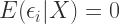
 and
and  are unbiased and have minimum variance among all unbiased linear estimators. The Gauss-Markov Theorem is telling us that in a regression model, where the expected value of our error terms is zero,
  and variance of the error terms is constant and finite
  and
and  and
and  are uncorrelated for all
  and
and  the least squares estimator
  , which we will denote as
  . In general start by mathematically formalizing relationships we think are present in the real world and write it down in a formula.
 Economic Theory Blog